
Blog
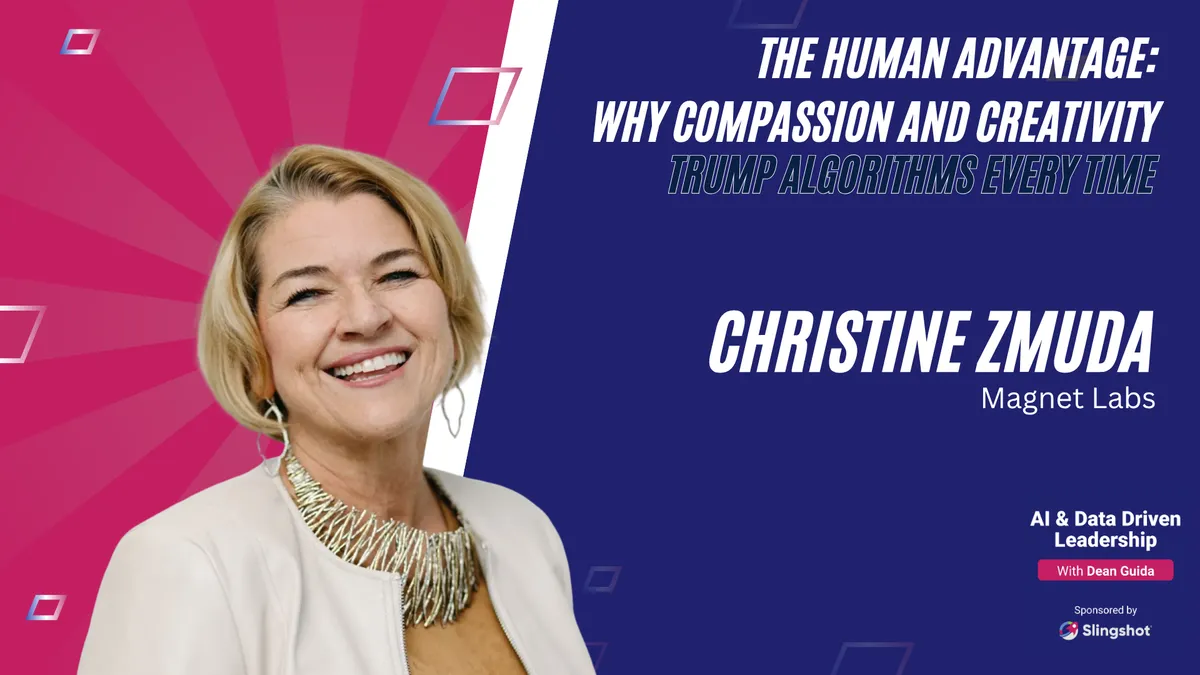
79 - The Human Advantage: Why Compassion and Creativity Trump Algorithms Every Time
Leading Through AI Transformation: Neuroscience-Backed Strategies for Human-Centered Leadership
In a compelling episode of the AI & Data Driven Leadership Podcast, host Dean Guida sat down with Christine Zmuda, Co-Founder of Magnet Labs, to explore how executives can maintain a human-centered approach while navigating rapid technological change. Leveraging over three decades of enterprise leadership at tech giants like Microsoft and ExxonMobil, Christine shares neuroscience-backed frameworks designed to optimize executive focus and team performance. This conversation offers a practical guide for corporate leaders, VPs, and decision-makers looking to clear cognitive overload, eliminate decision friction, and foster psychological safety across their organizations.
Enhancing Human Capacity Through Neuroscience and Energy Mapping
As artificial intelligence automates routine operational tasks, an organization’s ultimate competitive advantage shifts toward distinctly human traits: creativity, discernment, and compassionate leadership. Christine Zmuda points out that simply layering AI onto broken, cluttered workflows results in organizational overload rather than true productivity gains. To combat cognitive clutter—the mental friction caused by competing priorities and constant context-switching—executives must move beyond vanity metrics and focus on high-impact initiatives that align with customer value. By applying neuroscience principles, leaders can categorize daily tasks by value and energy expenditure, eliminating low-impact noise and protecting bandwidth for strategic innovation.
To maximize team collaboration and prevent burnout, leadership must transition from rigid, outdated scheduling to data-informed energy mapping. Every team operates with natural cognitive rhythms, and forcing critical decision-making or creative brainstorming into low-energy time blocks causes unnecessary friction and fatigue. By surveying individual focus windows and mapping collaboration around peak energy periods, managers can optimize meeting schedules, increase employee engagement, and improve overall decision quality across complex projects.
Eliminating "decision debt"—the accumulation of unresolved or delayed choices that stall organizational momentum—requires a clear risk-assessment framework. Christine advocates utilizing the two-way door methodology: categorizing reversible, low-risk decisions as "two-way doors" that should be executed rapidly, while reserving deep deliberation for irreversible "one-way doors." Furthermore, as organizations deploy generic AI models, leaders must guard against the "mediocre middle"—the trap of relying on homogenized algorithmic outputs without applying human critical thinking. By pairing structured decision-making with compassionate, transparent leadership, executives can build resilient, high-performing teams capable of thriving through digital transformation.
About Christine Zmuda
Christine Zmuda is the Co-Founder of Magnet Labs and a seasoned executive coach with over 30 years of corporate experience at Microsoft, Yammer, and ExxonMobil. Specializing in neuroscience-backed leadership frameworks, executive energy mapping, and organizational refinement, Christine helps leadership teams optimize performance, clear cognitive clutter, and drive human-centered innovation in the AI era.
About Magnet Labs
Magnet Labs is an executive advisory and leadership development firm dedicated to helping organizations navigate digital transformation through human-centered strategies. By blending neuroscience, data analytics, and operational refinement, Magnet Labs equips leaders to clear decision bottlenecks, optimize team collaboration, and foster workplace cultures that maximize human potential alongside emerging technologies.
Links Mentioned in This Episode
Key Episode Highlights
Clearing Cognitive Clutter: Applying neuroscience principles to eliminate low-value tasks and protect executive focus for strategic initiatives.
Team Energy Mapping: Structuring collaboration and critical meetings around natural cognitive rhythms to boost productivity and prevent burnout.
Eliminating Decision Debt: Utilizing the one-way/two-way door framework to accelerate reversible choices and prevent organizational bottlenecks.
Avoiding the "Mediocre Middle": Why relying solely on generic AI models leads to homogenized strategies, and how human critical thinking maintains brand differentiation.
Compassionate Leadership as Strategy: How modeling transparency and psychological safety drives employee retention and innovation during major technological shifts.
Conclusion
The conversation with Christine Zmuda underscores that while AI provides unprecedented operational velocity, true market leadership depends on the human capacity to lead with clarity, empathy, and strategic focus. By clearing cognitive clutter, optimizing team energy, and making decisive, human-centered choices, executives can navigate technological transformation and position their organizations for sustainable long-term success.
Explore Slingshotapp.io to learn more about AI-driven leadership solutions, and if you’re a qualified leader interested in sharing your insights, apply to be a guest on the AI & Data Driven Leadership Podcast here.

Listen and Subscribe to the AI & Data Driven Leadership Podcast Now:
Say "Hey, Siri / Alexa. Play AI & Data Driven Leadership Podcast"






About The Host
Tech entrepreneur and CEO Dean Guida knows there’s a limit to what you can build with grit alone.
At sixteen, Dean bought the first IBM PC and fell in love with writing software. He went on to receive a Bachelor of Science degree in operation research from the University of Miami. After graduating, he was a freelance developer and wrote many systems for IBM and on Wall Street. At twenty-three, he started Infragistics to build UX/UI tools for professional software developers.
Seemingly overnight, Dean had to go from early internet coder to business operator—a feat that forced him to learn some of business’s biggest lessons on the job. He immediately began navigating the nuances of scaling a company, hiring and growing teams, and becoming a leader, a manager, and a mentor.
Fast-forward thirty-five years, and Dean’s tech company now has operations in six countries. More than two million developers use Infragistics software, and its client roster boasts 100 percent of the S&P 500, including Fidelity, Morgan Stanley, Exxon, Intuit, and Bank of America.

Media