
Blog
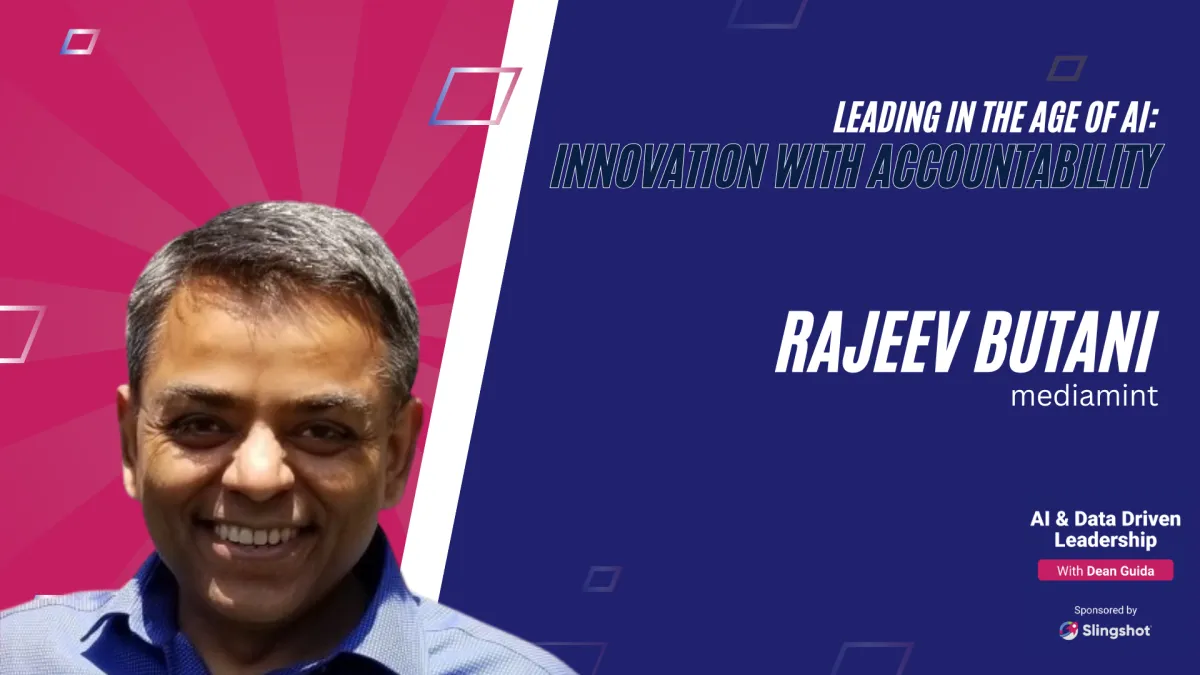
63 - Leading in the Age of AI: Innovation with Accountability
How Enterprises Can Harness AI for Operational Excellence: Insights from Rajeev Butani
In a recent episode of the AI & Data Driven Leadership Podcast, host Dean Guida sat down with Rajeev Butani, the Chairman and CEO of MediaMint, to discuss the pragmatic shift from AI hype to real-world operational impact. With a career spanning decades at Accenture and a deep expertise in scaling technology services, Rajeev offers a seasoned perspective on how global enterprises can move beyond experimental "chatbots" to build robust systems of operation. This conversation provides a masterclass for executives looking to integrate generative AI into high-volume workflows, focusing on the essential balance between machine efficiency and human accountability to drive measurable productivity gains without compromising data security or brand trust.
Persona-Based AI: The Next Frontier of Enterprise Productivity
The most effective way to deploy artificial intelligence within a complex organization is through a "persona-based" assistant model that mirrors specific job functions. Rather than waiting for broad SaaS platforms to release generic updates, leadership should focus on creating digital agents tailored to roles like media planners, sales representatives, or data analysts. These assistants function as a specialized layer on top of existing systems of record—such as a CRM or ERP—to orchestrate workflows, analyze historical performance, and draft recommendations. By targeting the unique pain points of a specific persona, companies have seen efficiency gains ranging from 30% to 70%, allowing high-value employees to move from manual data manipulation to strategic decision-making.
Successfully operationalizing AI requires a "Human-in-the-Loop" (HITL) framework to manage the probabilistic nature of generative models and mitigate the risk of hallucinations. Rajeev advocates for a "Star Network" model, where the AI agent resides at the edge of the workflow to process information at scale, while a human remains at the center as the ultimate orchestrator and validator. This ensures that any decision impacting revenue, compliance, or customer experience is backed by human accountability. By requiring human approval for the final execution of an AI-generated recommendation, enterprises can build the necessary layers of trust and transparency required to scale these tools across regulated industries and high-stakes environments.
As the industry shifts from traditional SaaS to "Service as Software," the criteria for selecting technology partners must also evolve to include end-to-end accountability for business outcomes. Enterprises should seek partners who do not merely deliver a tool, but who engage in co-innovation and provide operational stewardship throughout the entire lifecycle of the deployment. This includes managing the "frozen middle"—middle management who may resist change due to a lack of AI literacy or fear of replacement. By fostering an "AI-first" workforce and treating AI costs as a predictable operational expense rather than a runaway cloud bill, leaders can ensure that their digital transformation efforts result in a resilient, future-ready organization that values human ingenuity as much as algorithmic speed.
About Rajeev Butani
Rajeev Butani is the Chairman and CEO of MediaMint, a global leader in media operations and technology services. Prior to joining MediaMint, he spent 25 years at Accenture, where he served as a Senior Managing Director and led the Global Communications, Media, and Technology business, helping the world's most recognizable brands navigate massive shifts in digital consumer behavior and operational strategy.
About MediaMint
MediaMint provides operational excellence for the world's leading media and technology companies through a blend of human expertise and advanced automation. The company specializes in media planning, ad operations, and data analytics, helping publishers and platforms scale their business models and improve efficiency through the strategic deployment of persona-based AI assistants and integrated managed services.
Links Mentioned in This Episode
Key Episode Highlights
Persona-Based Productivity: How tailored AI assistants can drive 30–70% efficiency gains by focusing on role-specific tasks rather than generic automation.
The Star Network Model: A framework for maintaining a "human-in-the-loop" to ensure accountability and prevent errors in probabilistic AI systems.
Service as Software: Why the next wave of AI partnerships requires vendors to take accountability for business outcomes, not just technology delivery.
Thawing the "Frozen Middle": Strategies for upskilling middle management to champion AI initiatives and reduce organizational resistance to change.
AI Cost Governance: Lessons on how to avoid the "cloud cost trap" by monitoring token usage and optimizing AI workflows for predictable budgeting.
Conclusion
The conversation with Rajeev Butani underscores that AI is not a replacement for human talent, but a powerful catalyst for operational excellence when deployed with an operator’s mindset. By prioritizing role-specific agents, rigorous human oversight, and outcome-based partnerships, leaders can transform their data into actionable intelligence and lead their organizations into a new era of augmented productivity.
Explore Slingshotapp.io to learn more about AI-driven leadership solutions, and if you’re a qualified leader interested in sharing your insights, apply to be a guest on the AI & Data Driven Leadership Podcast here.

Listen and Subscribe to the AI & Data Driven Leadership Podcast Now:
Say "Hey, Siri / Alexa. Play AI & Data Driven Leadership Podcast"






About The Host
Tech entrepreneur and CEO Dean Guida knows there’s a limit to what you can build with grit alone.
At sixteen, Dean bought the first IBM PC and fell in love with writing software. He went on to receive a Bachelor of Science degree in operation research from the University of Miami. After graduating, he was a freelance developer and wrote many systems for IBM and on Wall Street. At twenty-three, he started Infragistics to build UX/UI tools for professional software developers.
Seemingly overnight, Dean had to go from early internet coder to business operator—a feat that forced him to learn some of business’s biggest lessons on the job. He immediately began navigating the nuances of scaling a company, hiring and growing teams, and becoming a leader, a manager, and a mentor.
Fast-forward thirty-five years, and Dean’s tech company now has operations in six countries. More than two million developers use Infragistics software, and its client roster boasts 100 percent of the S&P 500, including Fidelity, Morgan Stanley, Exxon, Intuit, and Bank of America.

Media