
Blog
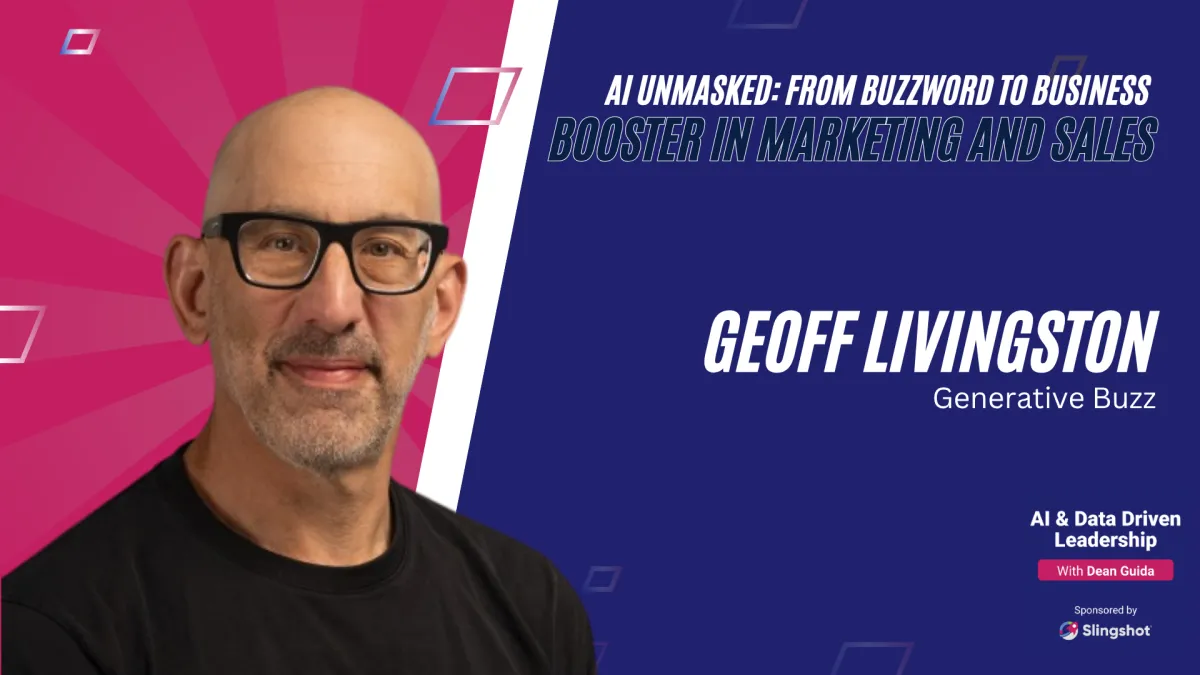
69 - AI Unmasked: From Buzzword to Business Booster in Marketing and Sales
Practical AI Adoption in Marketing and Sales: Insights from Geoff Livingston
In a value-packed episode of the AI & Data Driven Leadership Podcast, host Dean Guida sits down with Geoff Livingston, the founder of Generative Buzz, to cut through the noise surrounding artificial intelligence and outline a realistic road map for enterprise growth. While many executive boards remain caught up in the hyperbole of complete workforce displacement, forward-thinking organizations are quietly focusing on practical applications that drive measurable efficiency. This conversation serves as a foundational guide for mid-market leaders and enterprise executives who want to move past casual tool experimentation and unlock the true competitive advantages of data unification, secure workflow automation, and human-machine collaboration.
Shifting from AI Novelty to Enterprise Workflow Integration
True artificial intelligence maturity requires moving beyond basic sandbox tools toward deeply integrated systems that actively orchestrate day-to-day business operations. Playing around with prompts inside standalone web interfaces provides an illusion of productivity, but it fails to generate repeatable, scalable value for an enterprise. For marketing and sales teams to capture a sustainable return on investment, AI must be woven directly into core business processes using custom plugins, workflow automation connectors, and shared technical skills. This operational layer allows organizations to automate high-volume administrative tasks, reduce human friction points, and shift internal talent from rote data processing to strategic revenue-driving initiatives.
The performance of any deployment relies fundamentally on the structural integrity of the underlying corporate data architecture. Siloed, dirty, or completely inaccessible data across disconnected CRM, marketing automation, and ERP platforms inherently cripples the predictive power of intelligent algorithms. Enterprise leaders must prioritize comprehensive data audits and system unification strategies to establish a verified, single source of truth for their customer journeys. By securely feeding proprietary context into domain-specific models, companies can accurately analyze complex buyer behaviors, isolate operational leaks, and optimize marketing spend with an empirical precision that legacy infrastructure simply cannot support.
Successfully scaling these technical frameworks across an enterprise is ultimately a challenge of organizational culture and clear leadership alignment rather than technical execution alone. Because anxiety over job security can stall technological adoption, executives must openly communicate that AI functions as a powerful collaborator designed to amplify human capabilities, not replace them. Leaders can proactively dismantle cultural resistance by establishing cross-functional task forces, investing heavily in hands-on technical training, and rewarding teams that champion automated workflow efficiency. When an organization treats technological transformation as an ongoing journey of human empowerment, it builds a resilient, future-ready culture capable of sustaining long-term growth.
About Geoff Livingston
Geoff Livingston is the Founder of Generative Buzz and a veteran marketing strategist with decades of experience guiding mid-market firms and enterprises through complex digital transformations. An author, speaker, and specialist in emerging technologies, Geoff focuses on helping companies cut through media hype to implement secure, practical AI solutions that drive measurable business outcomes.
About Generative Buzz
Generative Buzz is an AI adoption and strategic consulting firm that helps organizations integrate intelligent technologies into their existing marketing and sales operations. The company specializes in workflow automation, data readiness assessments, and team training frameworks, ensuring businesses can leverage advanced models to maximize productivity and build a defensible strategic moat.
Links Mentioned in This Episode
Key Episode Highlights
The Experimentation Trap: Why standalone use of public tools fails to scale and how to shift toward repeatable enterprise workflow automation.
Unifying the Data Foundation: The critical requirement of breaking down organizational data silos to feed clean, contextual data into intelligent systems.
Reframing Workforce Fear: Strategies for leadership to position automation as an operational enabler that eliminates busywork and boosts employee morale.
Data-Driven Channel Optimization: Using deep customer journey analytics to identify underperforming assets and maximize marketing spend efficiency.
Custom Moats vs. Generic Models: The competitive advantage of encoding unique decision-making processes into smaller, localized AI architectures.
Conclusion
The conversation with Geoff Livingston illuminates a pragmatic path forward where technology serves as an accelerator for human ingenuity rather than its replacement. By focusing heavily on data cleanliness, workflow integration, and a transparent, supportive corporate culture, mid-market and enterprise leaders can confidently transform artificial intelligence from a speculative tech trend into a robust engine for scalable revenue growth.
Explore Slingshotapp.io to learn more about AI-driven leadership solutions, and if you’re a qualified leader interested in sharing your insights, apply to be a guest on the AI & Data Driven Leadership Podcast here.

Listen and Subscribe to the AI & Data Driven Leadership Podcast Now:
Say "Hey, Siri / Alexa. Play AI & Data Driven Leadership Podcast"






About The Host
Tech entrepreneur and CEO Dean Guida knows there’s a limit to what you can build with grit alone.
At sixteen, Dean bought the first IBM PC and fell in love with writing software. He went on to receive a Bachelor of Science degree in operation research from the University of Miami. After graduating, he was a freelance developer and wrote many systems for IBM and on Wall Street. At twenty-three, he started Infragistics to build UX/UI tools for professional software developers.
Seemingly overnight, Dean had to go from early internet coder to business operator—a feat that forced him to learn some of business’s biggest lessons on the job. He immediately began navigating the nuances of scaling a company, hiring and growing teams, and becoming a leader, a manager, and a mentor.
Fast-forward thirty-five years, and Dean’s tech company now has operations in six countries. More than two million developers use Infragistics software, and its client roster boasts 100 percent of the S&P 500, including Fidelity, Morgan Stanley, Exxon, Intuit, and Bank of America.

Media