
Blog
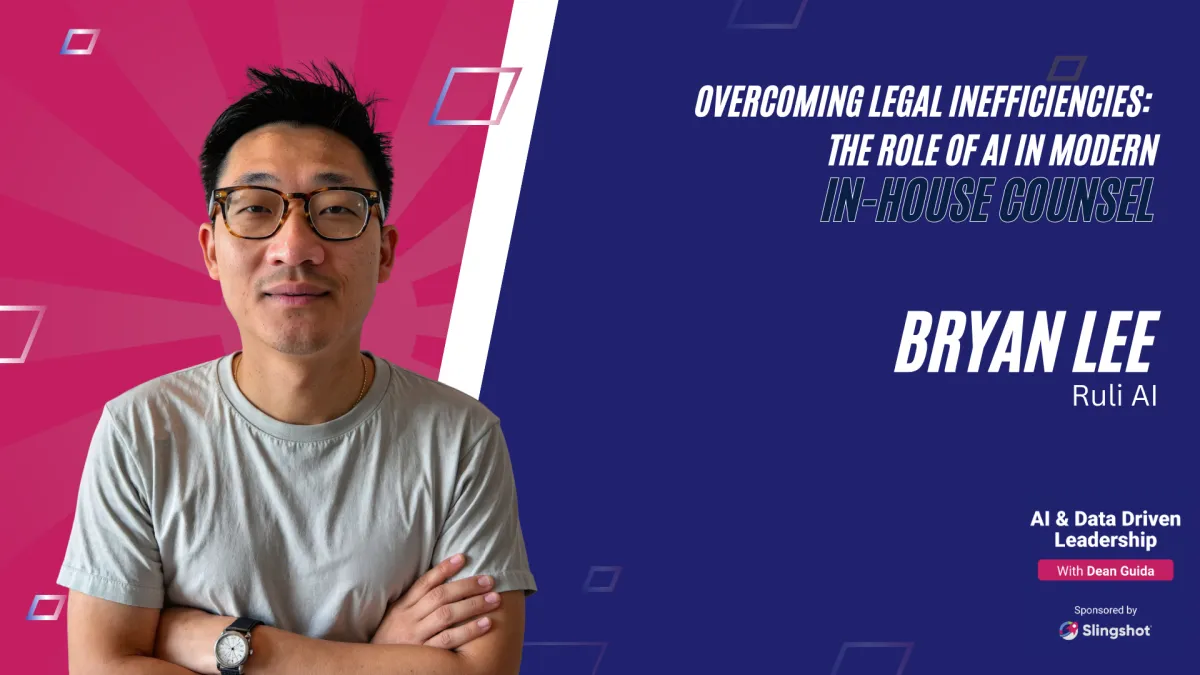
54 - Overcoming Legal Inefficiencies: The Role of AI in Modern In-House Counsel
How Ruli AI is Transforming In-House Legal Teams: Insights from CEO Bryan Lee
In this episode of the AI & Data Driven Leadership Podcast, host Dean Guida sits down with Bryan Lee, the Cofounder and CEO of Ruli AI, to discuss the profound shift occurring within corporate legal departments. As a computer engineer turned lawyer with a decade of experience at tech giants like Google and Meta, Bryan offers a rare dual perspective on how artificial intelligence can move beyond simple contract review to become a "legal intelligence platform." This conversation provides a strategic roadmap for leaders looking to reduce their reliance on expensive outside counsel, automate high-volume regulatory tasks, and empower understaffed legal teams with AI agents that act as a "second brain" for the organization.
Orchestrating the Future of Legal Intelligence
The traditional in-house legal department is often treated as a "black box" or a bottleneck, burdened by a massive variety of tasks ranging from HR compliance to marketing reviews. Bryan explains that Ruli AI solves the "everything else" problem by integrating directly into the tools lawyers already use, such as Microsoft Word and Outlook, to provide real-time, context-aware assistance. By leveraging a company’s own internal files and historical legal advice, these AI agents can conduct research with accurate citations and perform first-pass contract redlining based on a specific corporate risk playbook. This move toward "Counsel-in-the-Loop" workflows ensures that human expertise is preserved for high-stakes decision-making while the AI handles the repetitive, time-consuming data processing.
To bridge the gap between technical potential and legal trust, Ruli AI prioritizes rigorous privacy and accuracy standards, including SOC 2 Type 2 certification and granular data controls. Bryan highlights that "hallucinations"—a common deterrent for legal AI adoption—are significantly mitigated through rich, company-specific context and innovative "magic prompts" that expand simple keywords into detailed legal queries. This approach transforms the AI from a generic chatbot into a specialized assistant that understands the nuances of a specific industry and company culture. For leadership, this means higher output quality without the typical security risks associated with public generative models, allowing the legal team to scale its impact without linearly increasing its headcount.
Looking toward the next five years, the role of the corporate lawyer is evolving from a manual producer of documents to an orchestrator of AI agents. Bryan envisions a future where AI agents from different departments—such as Sales and Legal—can negotiate routine terms autonomously, only escalating exceptions to their human counterparts. This shift requires a collaborative culture where engineers and lawyers speak a common language of product and risk. By adopting these agentic workflows today, companies can build a collective knowledge base that survives employee turnover and provides a competitive advantage in navigating an increasingly complex global regulatory landscape.
About Bryan Lee
Bryan Lee is the Cofounder and CEO of Ruli AI, a legal intelligence platform designed specifically for in-house legal teams. With a background as both a computer engineer and an attorney, and extensive experience leading product and legal initiatives at Google and Meta, he is a leading voice on the intersection of technology, law, and organizational efficiency.
About Ruli AI
Ruli AI provides an AI-native platform that empowers in-house legal departments to automate complex workflows, conduct deep legal research, and manage institutional knowledge. By meeting lawyers where they work—in Word and email—Ruli AI helps companies reduce outside counsel spend and accelerate business velocity while maintaining high standards of security and privacy.
Links Mentioned in This Episode
Key Episode Highlights
Solving the "Everything Else" Problem: Why legal tech must move beyond contract lifecycle management (CLM) to support the diverse, daily needs of in-house counsel.
The Magic Prompt Framework: How Ruli AI uses prompt engineering to help lawyers overcome "the blank page" and generate high-accuracy legal outputs.
Orchestrating AI Agents: A vision for the future where legal professionals manage a fleet of specialized AI agents to handle routine negotiations and compliance.
Privacy as a Foundation: The importance of SOC 2 compliance and granular data controls in building trust with risk-averse legal departments.
The "Second Brain" for Legal: How AI can capture and reuse the collective wisdom of a legal team, ensuring that insights from outside counsel are never lost.
Conclusion
The conversation with Bryan Lee underscores that the most successful AI implementations in the legal sector are those that respect existing workflows while fundamentally expanding what a small team can achieve. By focusing on company-specific context and user-centric design, Ruli AI is demonstrating how technology can turn a legal department from a cost center into a strategic engine for growth.
Explore Slingshotapp.io to learn more about AI-driven leadership solutions, and if you’re a qualified leader interested in sharing your insights, apply to be a guest on the AI & Data Driven Leadership Podcast here.

Listen and Subscribe to the AI & Data Driven Leadership Podcast Now:
Say "Hey, Siri / Alexa. Play AI & Data Driven Leadership Podcast"






About The Host
Tech entrepreneur and CEO Dean Guida knows there’s a limit to what you can build with grit alone.
At sixteen, Dean bought the first IBM PC and fell in love with writing software. He went on to receive a Bachelor of Science degree in operation research from the University of Miami. After graduating, he was a freelance developer and wrote many systems for IBM and on Wall Street. At twenty-three, he started Infragistics to build UX/UI tools for professional software developers.
Seemingly overnight, Dean had to go from early internet coder to business operator—a feat that forced him to learn some of business’s biggest lessons on the job. He immediately began navigating the nuances of scaling a company, hiring and growing teams, and becoming a leader, a manager, and a mentor.
Fast-forward thirty-five years, and Dean’s tech company now has operations in six countries. More than two million developers use Infragistics software, and its client roster boasts 100 percent of the S&P 500, including Fidelity, Morgan Stanley, Exxon, Intuit, and Bank of America.

Media