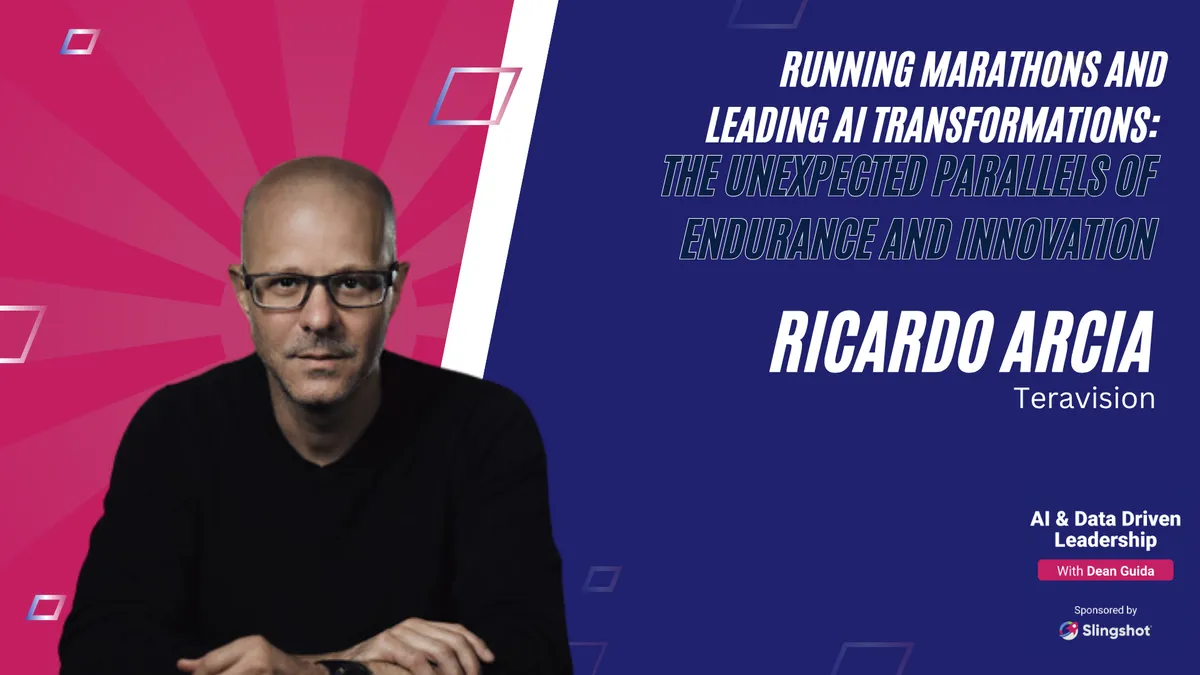
74 - Running Marathons and Leading AI Transformations: The Unexpected Parallels of Endurance and Innovation
How AI is Transforming Software Development: Leadership, Teams, and the Cognitive Edge
In a compelling episode of the AI & Data Driven Leadership Podcast, host Dean Guida sits down with Ricardo Arcia, CEO & Co-Founder of Teravision Technologies, to unpack how artificial intelligence is fundamentally restructuring software delivery and corporate leadership. Drawing from a 25-year entrepreneurial journey and deep experience guiding enterprise engineering organizations, Ricardo shares hard-earned lessons on shifting technical teams from traditional coding to AI orchestration. This conversation provides an actionable masterclass for CTOs, product leaders, and executives aiming to eliminate workflow bottlenecks, measure true operational ROI, and lead high-performing teams through the probabilistic landscape of modern software engineering.
Scaling Software Velocity through the Cognitive Engineering Framework
Integrating artificial intelligence into software engineering is far more than a tool upgrade; it requires a total realignment of people, processes, and delivery architecture. Ricardo Arcia points out that isolated productivity spikes—such as QA teams using generative tools to write test matrices in minutes—often backfire by creating severe downstream bottlenecks for developers who cannot keep up. To prevent chaotic process amplification, technology leaders must deploy a synchronized, framework-driven approach. By establishing a dedicated delivery unit to pilot continuous 90-day iteration loops, organizations can build a customized operational playbook that aligns junior and senior engineers alike, transforming raw tool velocity into measurable business outcomes.
Successfully scaling these hybrid workflows requires moving past the deterministic mindset of legacy software development to embrace a probabilistic model. As product roles converge and AI token consumption increases, the primary operational constraint shifts from writing syntax to generating precise, high-context product requirements. Without crystal-clear documentation, generative tools waste expensive compute tokens on flawed outputs that accumulate technical debt. Leaders must invest heavily in upskilling product managers, solution architects, and designers to provide high-fidelity context upfront, ensuring that AI-generated code remains clean, secure, and tightly aligned with enterprise architecture.
Ultimately, navigating this transition is a leadership challenge rooted in culture and organizational transparency rather than technology alone. Engineers often experience an identity shift when moving from manual coding to system validation, requiring explicit leadership permission to experiment, fail, and adapt. As detailed in Ricardo’s book, The Cognitive Leader, executives must foster an environment of "productive discomfort" where transparency around unknown variables builds psychological safety. By defining clear productivity metrics, managing model consumption costs, and orchestrating human ingenuity alongside automated systems, leaders can build a resilient digital infrastructure that thrives on continuous change.
About Ricardo Arcia
Ricardo Arcia is the CEO & Co-Founder of Teravision Technologies, a nearshore software development firm with over two decades of experience building custom enterprise solutions. An accomplished entrepreneur, author, and technology strategist, Ricardo specializes in helping executive teams operationalize artificial intelligence, transform engineering cultures, and navigate digital transformation through cognitive leadership frameworks.
About Teravision Technologies
Teravision Technologies is a custom software development company that partners with businesses across North America to design, build, and scale digital products. By combining nearshore engineering talent with cutting-edge AI orchestration frameworks, the firm helps clients accelerate product delivery, optimize software quality, and modernize legacy IT infrastructures.
Links Mentioned in This Episode
Key Episode Highlights
The Orchestration Trap: Why isolated AI productivity gains in single departments create bottlenecks across the broader software development lifecycle.
The "Team Zero" Strategy: How deploying a dedicated vanguard team to pilot new AI workflows creates a practical, reusable transfer playbook for the entire enterprise.
Managing Token Economics: Operational strategies for controlling AI API and token costs by sharpening product requirements and context inputs.
The 90-Day Execution Loop: A framework for running short, feedback-driven iterations to measure, adapt, and scale AI adoption without "big bang" risks.
The Cognitive Leader Mindset: Why modern CTOs and VPs of Engineering must evolve from managing technical output to orchestrating people, processes, and intelligent agents.
Conclusion
The conversation with Ricardo Arcia reinforces that long-term competitive advantage belongs to leaders who balance technological speed with structural discipline and human-centered leadership. By implementing clear frameworks, managing operational costs, and fostering a culture of continuous learning, organizations can turn the complexities of AI development into a sustainable engine for software excellence.
Explore Slingshotapp.io to learn more about AI-driven leadership solutions, and if you’re a qualified leader interested in sharing your insights, apply to be a guest on the AI & Data Driven Leadership Podcast here.


