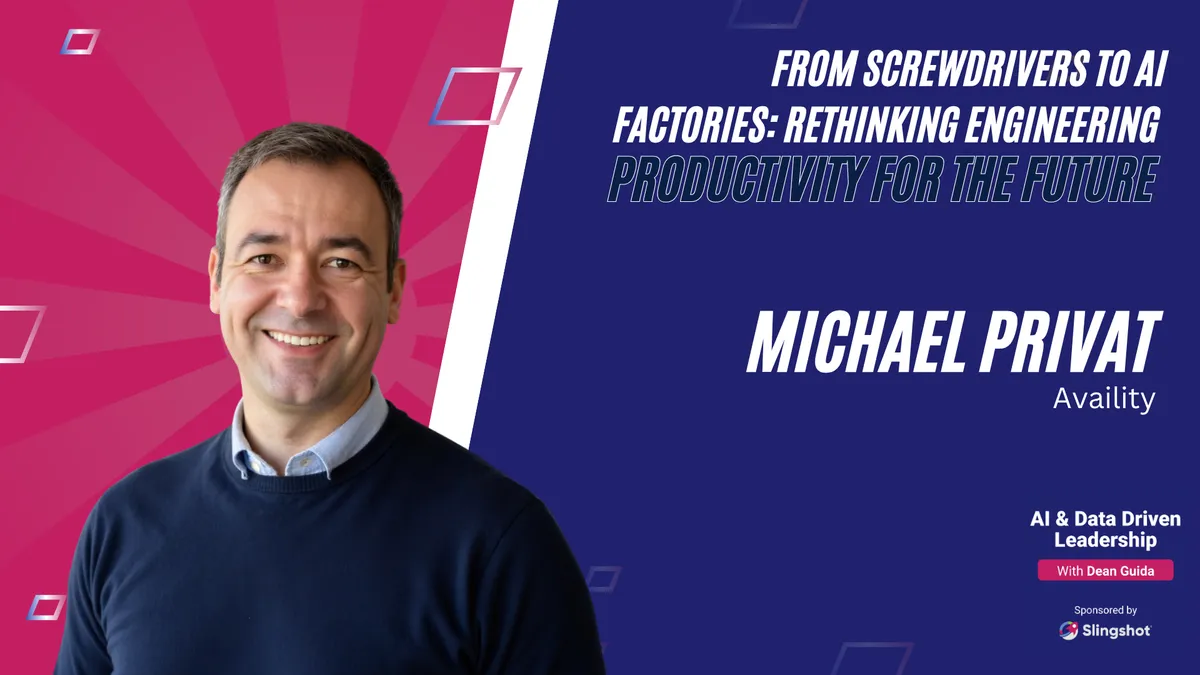
78 - From Screwdrivers to AI Factories: Rethinking Engineering Productivity for the Future
Building High-Performing Engineering Teams in the Age of AI: Insights from Michael Privat
In a compelling episode of the AI & Data Driven Leadership Podcast, host Dean Guida sat down with Michael Privat, Chief Data & Engineering Officer at Availity, to dissect the evolving landscape of software engineering and leadership in an AI-first world. Drawing from over 25 years of experience transforming technical organizations and authoring High Performing Teams, Michael shares a masterclass in shifting engineering cultures from basic developer tooling to true autonomous workflows. This conversation offers an essential roadmap for CTOs, engineering VPs, and technology leaders focused on eliminating operational toil, accelerating onboarding velocity, and designing resilient platform architectures that drive measurable business value.
Driving Operational Excellence Through Autonomous Engineering Workflows
Transforming a software organization in the intelligence era requires moving past the illusion of simple developer acceleration to re-engineer end-to-end operational workflows. Michael Privat points out that swapping traditional coding for AI assistance is merely replacing a manual tool with a power tool; true operational leverage happens when AI functions as an autonomous factory that executes routine tasks independently. When technical leaders attempt to scale output without redesigning their processes, human review bottlenecks inevitably emerge, increasing system complexity without delivering proportional value. By establishing clear delegation boundaries and reserving human intervention strictly for high-risk exception handling, organizations can achieve a step-change increase in engineering throughput while maintaining absolute architectural control.
Eliminating systemic "toil"—the repetitive, low-value work that consumes engineering bandwidth—demands that every technical initiative align directly with revenue growth, margin expansion, or system reliability. When evaluating team performance, traditional metrics like story point velocity or release frequency often mask underlying operational friction. High-performing engineering cultures focus instead on developer onboarding velocity, measuring how rapidly a new engineer can make meaningful, production-ready contributions within a single day. Achieving this level of organizational agility requires treating internal developer platforms as dedicated products, continually refining user experience, simplifying codebase architecture, and ruthlessly subtracting redundant processes before adding new software layers.
Successfully navigating enterprise-wide AI adoption also requires a balanced hybrid model that carefully pairs deterministic software reliability with probabilistic model capabilities. In heavily regulated sectors like healthcare, core business logic and compliance rules must remain anchored in testable, deterministic code, deploying generative models specifically for complex exception management, pattern detection, and automated research. Furthermore, as AI tools narrow the technical syntax gap between junior and senior developers, the primary talent differentiator shifts toward deep business domain mastery and organizational agency. By empowering curious, domain-literate engineering teams to direct intelligent agents within a simplified architectural framework, leaders can build an agile, future-proof engineering engine built for sustainable growth.
About Michael Privat
Michael Privat is the Chief Data & Engineering Officer at Availity and the author of High Performing Teams. With more than two decades of executive leadership experience spanning software architecture, data strategy, and enterprise digital transformation, Michael specializes in building fast, accountable engineering organizations that align cutting-edge technology initiatives directly with core business metrics.
About Availity
Availity is the nation’s largest real-time health information network, connecting healthcare providers, health plans, and technology partners. The company delivers administrative, clinical, and financial data solutions that streamline healthcare operations, reduce administrative burden, and optimize patient care delivery across the healthcare ecosystem.
Links Mentioned in This Episode
Key Episode Highlights
From Power Tool to Autonomous Factory: Why real productivity leaps happen when AI handles workflows independently rather than just speeding up manual coding.
The Onboarding Velocity Metric: Measuring team health and architectural clarity by how quickly a new developer can contribute to production.
Toil Elimination Framework: Filtering all engineering initiatives through three core business metrics: revenue growth, margin expansion, and system reliability.
Deterministic vs. Probabilistic Balance: Keeping core business logic testable and deterministic while leveraging AI for complex pattern recognition and exception handling.
Platform Engineering as a Product: Treating internal developer platforms as products where success is measured by developer adoption and satisfaction.
Conclusion
The conversation with Michael Privat serves as a powerful reminder that engineering leadership in the AI age is rooted in clarity, domain understanding, and ruthless simplification. By subtracting unnecessary complexity, focusing on developer onboarding agility, and thoughtfully orchestrating human talent alongside autonomous agents, executives can build resilient engineering organizations that consistently deliver business impact.
Explore Slingshot.io to learn more about AI-driven leadership solutions, and if you’re a qualified leader interested in sharing your insights, apply to be a guest on the AI & Data Driven Leadership Podcast here.


