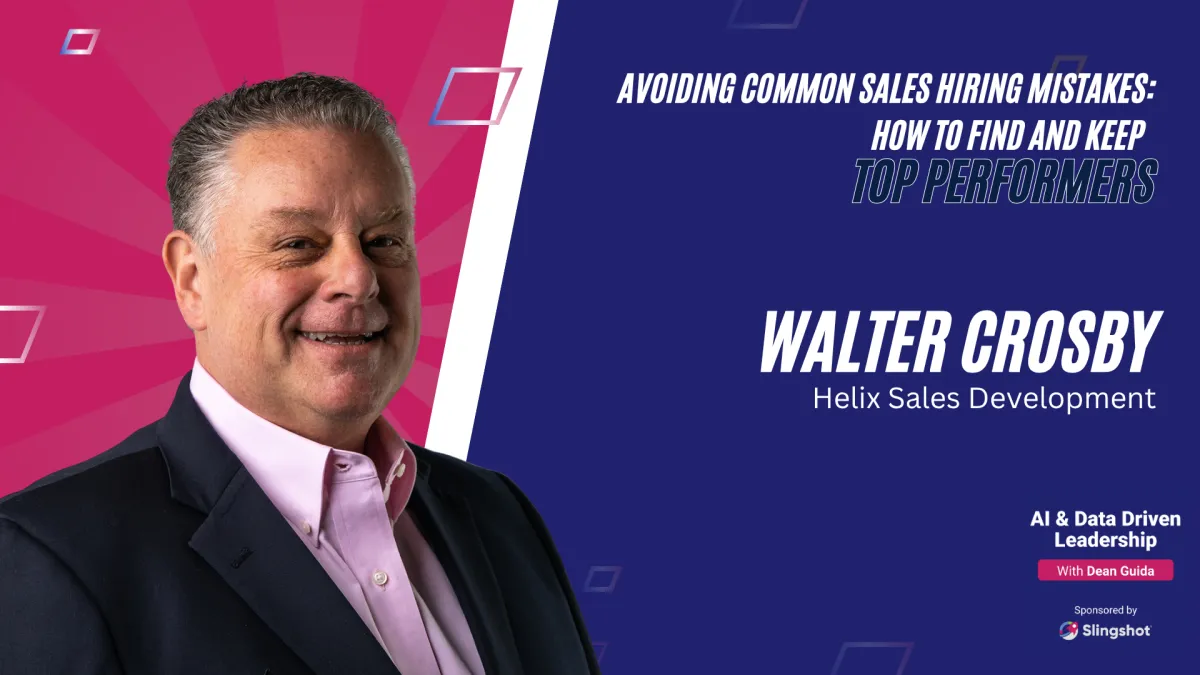
67 - Avoiding Common Sales Hiring Mistakes: How to Find and Keep Top Performers
Building a Scalable Sales Organization: Expert Insights from Walter Crosby
In a power-packed episode of the AI & Data Driven Leadership Podcast, host Dean Guida sits down with Walter Crosby, CEO of Helix Sales Development, to dismantle the "founder dependency" trap that keeps many organizations from scaling. Walter brings over 40 years of sales expertise, specializing in the difficult transition from a founder-led sales model to a structured, data-driven revenue engine. This conversation is essential for any leader who feels they are the only person capable of closing deals; it provides a masterclass on diagnosing sales friction, implementing rigorous hiring frameworks, and using leading indicators to build an accountable team that delivers consistent, predictable growth.
Mastering the Science of Scalable Sales Teams
Scaling a sales organization requires moving beyond "gut feeling" and charisma toward a disciplined, documented methodology. Walter Crosby explains that the most common mistake founders make is assuming every sales slump is a training problem, when it is often an issue of pipeline hygiene or leadership accountability. By auditing how often a salesperson requires a founder’s intervention to close, leaders can pinpoint exactly where the value proposition is being lost in translation. Establishing a consistent sales playbook—documenting the founder's stories, objection handling, and value messaging—ensures that the entire team speaks the same language, transforming sales from a mysterious art into a repeatable science.
Building an elite sales team starts with an objective, data-driven hiring process that prioritizes "sales DNA" over industry pedigree. Traditional interviews often favor the candidate who can sell themselves best, which rarely translates to the discipline required for complex B2B discovery. Walter advocates for a rigorous disqualification process, where candidates are filtered based on their ability to handle rejection and their genuine desire to solve buyer problems. Once the right people are in place, leadership must spend at least half of their time coaching—asking questions that help reps self-diagnose their gaps rather than simply handing them the answers. This culture of coaching, paired with accountability meetings focused on deal progression, creates a high-performance environment where success is expected rather than hoped for.
As artificial intelligence begins to reshape the sales landscape, leaders must discern where technology adds efficiency and where it generates noise. While AI is a powerhouse for drafting proposals, conducting prospect research, and automating administrative data entry, it cannot replace the trust and rapport built through human discovery. High-performing organizations use technology to handle the rote tasks of the sales cycle, freeing up their human talent to engage in the nuanced, high-stakes problem-solving that modern buyers demand. Ultimately, a scalable sales organization is built on the foundation of clean data, aligned compensation plans that reward margin over volume, and a relentless focus on the fundamentals of the sales process.
About Walter Crosby
Walter Crosby is the CEO of Helix Sales Development, a consultancy dedicated to helping business owners and CEOs build scalable, high-performing sales teams. With a career spanning four decades, Walter is an expert in identifying the behavioral and competency gaps that prevent sales organizations from reaching their full potential, helping companies transition from founder-led sales to professional, accountable operations.
About Helix Sales Development
Helix Sales Development provides the tools and training necessary for businesses to hire the right sales talent and implement a winning sales methodology. The firm specializes in using objective, AI-driven assessments and structured coaching frameworks to help organizations eliminate sales bottlenecks and achieve predictable revenue growth.
Links Mentioned in This Episode
Key Episode Highlights
Founder-to-Team Transition: Strategies for documenting tribal knowledge and reducing the organization's reliance on the founder's personal involvement in deals.
Pipeline Hygiene vs. Sales Skills: Why a drop in close rates is often a symptom of poor lead qualification rather than a lack of selling ability.
Objective Sales Hiring: The importance of using structured assessments to measure a candidate's core sales competencies and "will to sell" over their personality.
Coaching as Leadership: Why sales managers should spend 50% of their time on pre-call planning and post-call debriefs to foster rep self-sufficiency.
The Role of AI in Sales: Identifying the balance between using AI for operational efficiency and maintaining the human touch in complex B2B relationships.
Conclusion
The conversation with Walter Crosby highlights that the difference between a stagnant sales team and an elite one is often found in the rigor of their process and the quality of their leadership. By focusing on leading indicators and building a culture of coaching, founders can finally step away from the front lines and build an organization that thrives independently.
Explore Slingshotapp.io to learn more about AI-driven leadership solutions, and if you’re a qualified leader interested in sharing your insights, apply to be a guest on the AI & Data Driven Leadership Podcast here.


