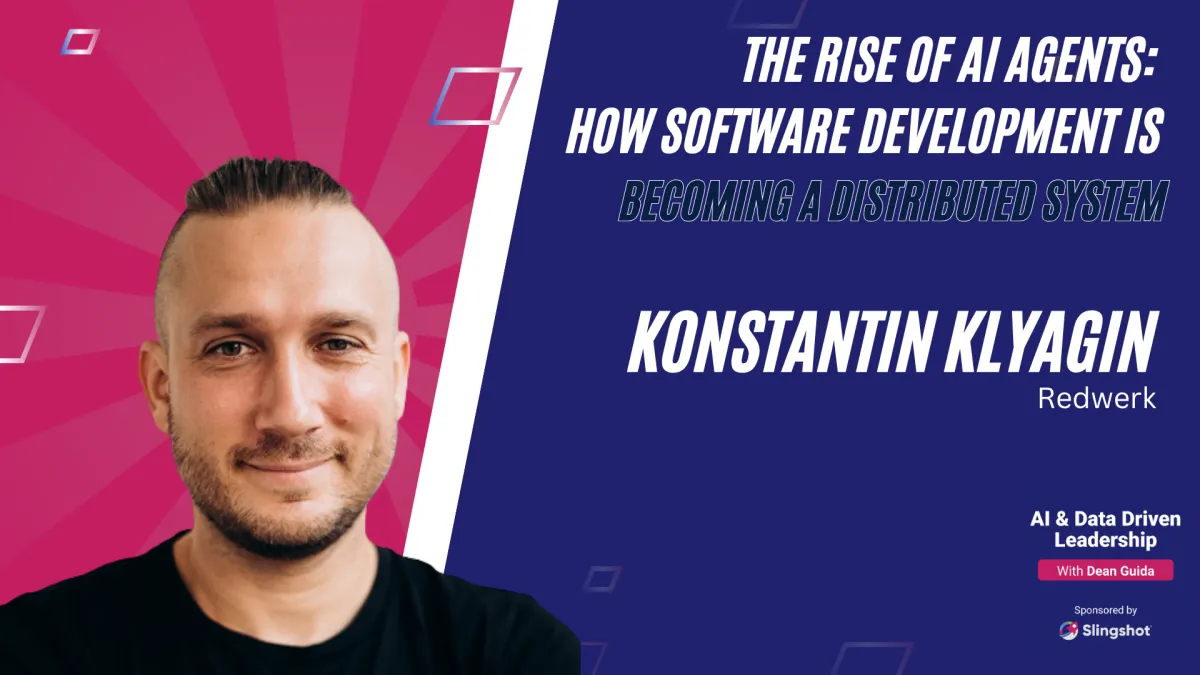
73 - The Rise of AI Agents: How Software Development Is Becoming a Distributed System
Harnessing AI in Software Development: Insights and Actionable Strategies from Konstantin Klyagin
In a recent episode of the AI & Data Driven Leadership Podcast, host Dean Guida sat down with Konstantin Klyagin, Founder of Redwerk, to break down how generative AI is fundamentally reshaping the software engineering ecosystem. Drawing from more than two decades of global technical delivery—ranging from European Parliament platforms to high-scale fintech systems—Konstantin offers an essential reality check for CTOs, founders, and product leaders looking to integrate large language models and autonomous code generators. This conversation provides an actionable masterclass on balancing rapid AI prototyping with uncompromising engineering rigor, navigating technical debt, and building resilient software architectures in an age where code generation has been completely commoditized.
Balancing AI-Driven Speed with Engineering Discipline
The rise of AI-assisted development tools and non-technical "vibe coding" has dramatically lowered the barrier to entry for software creation, but it has simultaneously amplified systemic technical debt. Konstantin Klyagin explains that while generative tools act as massive productivity multipliers for rapid prototyping and MVP validation, they double as risk multipliers when deployed directly into production environments without strict human oversight. Relying solely on AI-generated code without enforcing traditional quality assurance creates fragile systems rife with security vulnerabilities, unhandled edge cases, and fragmented business logic. To prevent customers from becoming de facto software testers, modern engineering leaders must mandate rigorous code reviews, automated integration testing, and comprehensive QA protocols before any AI-assisted release touches production.
Transitioning a low-code or AI-generated prototype into a scalable enterprise application requires a fundamental shift in how organizations define developer productivity and system architecture. Measuring velocity by raw lines of code or feature completion rates is an outdated paradigm that rewards sloppy development over long-term stability. Instead, organizations should prioritize systems thinking, architectural integrity, and holistic workflow comprehension, recognizing that AI is built to replace repetitive syntax drafting rather than high-level engineering judgment. When non-technical founders bring "vibe-coded" applications to market, experienced engineering teams must step in to refactor backend architectures, audit user permissions, and establish proper database monitoring to ensure the platform can safely scale alongside user growth.
As multi-agent AI systems become more prevalent across software stacks, technical leaders must also prepare for the unique governance and security challenges inherent to autonomous agent interactions. Multi-agent deployments closely resemble complex distributed systems, meaning minor errors in prompt logic or API responses can cascade into widespread platform failures or security breaches. Establishing strict governance frameworks—including role-based access controls, comprehensive audit trails, and clear rollback procedures—is non-negotiable for organizations deploying autonomous agents into live workflows. By blending the sheer execution speed of modern generative tools with time-tested software engineering fundamentals, forward-thinking businesses can build applications that are not only fast to market, but also secure, maintainable, and built for long-term growth.
About Konstantin Klyagin
Konstantin Klyagin is a veteran software developer, tech entrepreneur, and the Founder of Redwerk. With over 20 years of experience in the IT industry, he has led the delivery of complex software solutions for enterprise clients, government bodies, and high-growth startups globally. Konstantin is a passionate advocate for engineering discipline, pragmatic AI adoption, and high-standard software quality assurance.
About Redwerk
Redwerk is a full-agency software development firm specializing in custom web and mobile application development, code refactoring, and comprehensive quality assurance. The company helps startups and enterprise organizations turn complex technical concepts into robust, production-ready software, offering specialized services in auditing, cleaning, and scaling AI-generated prototypes.
Links Mentioned in This Episode
Key Episode Highlights
Productivity Multiplier vs. Risk Amplifier: Why rapid AI code generation requires even stronger quality assurance to prevent catastrophic technical debt.
The "Vibe Coding" Reality Check: A practical framework for transitioning non-technical, AI-generated prototypes into production-ready enterprise software.
Redefining Productivity Metrics: Shifting developer evaluation away from raw lines of code toward architectural health, security, and systems thinking.
Multi-Agent Governance: Navigating the hidden complexities, cascading errors, and security risks of multi-agent distributed systems.
The Evolving Agency Model: How software development partners are transitioning from basic code writing to specialized code cleanup, refactoring, and AI integration.
Conclusion
The conversation with Konstantin Klyagin reinforces that while AI can draft code in seconds, sustainable digital transformation relies on human expertise, architectural discipline, and strategic oversight. By using AI for rapid iteration while upholding rigorous software engineering standards, leaders can build scalable, high-performing products that stand the test of time.
Ready to optimize your team's workflow and turn complex data into actionable leadership strategies? Explore Slingshot.io to discover how our digital workplace solutions drive organizational productivity, and if you're an experienced executive ready to share your expertise on the front lines of innovation, apply to be a guest on the AI & Data Driven Leadership Podcast here.


