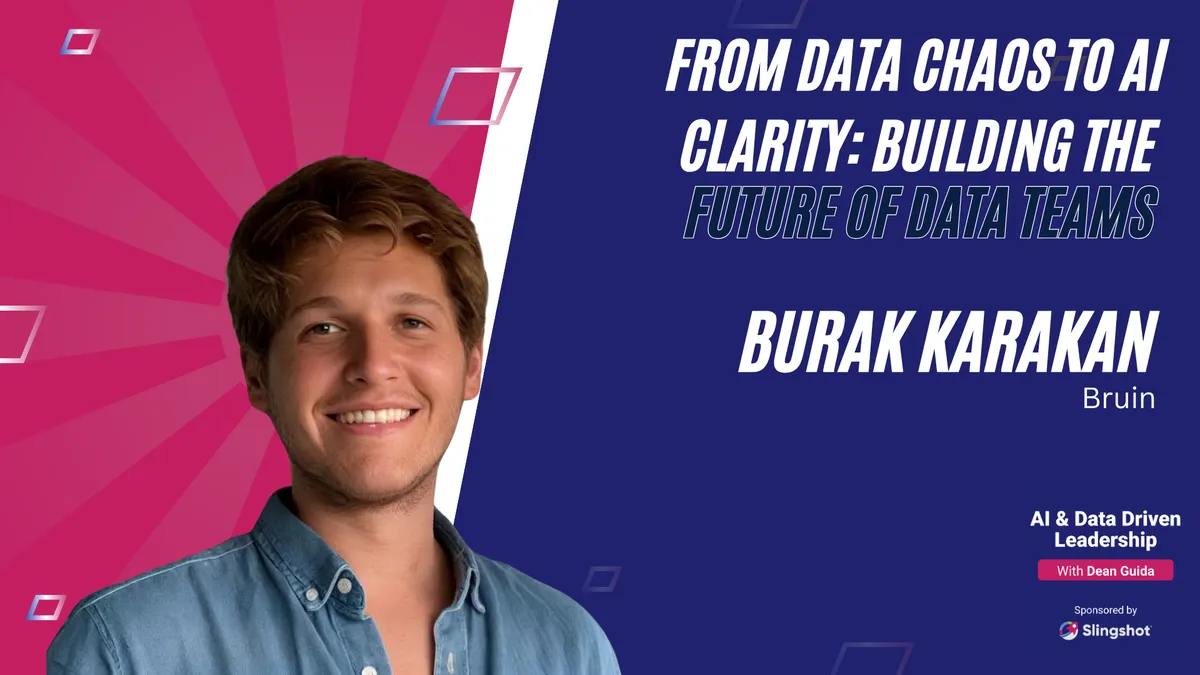
80 - From Data Chaos to AI Clarity: Building the Future of Data Teams
Rethinking the Modern Data Stack: How AI Agents and Open Source Platforms Are Transforming Data Teams
In a recent episode of the AI & Data Driven Leadership Podcast, host Dean Guida sat down with Burak Karakan, Co-Founder & CEO of Bruin, to unpack the structural failures plaguing the modern data stack and explore how artificial intelligence is transforming data operations. Drawing on his experience scaling infrastructure at HelloFresh and building Bruin, Burak provides an authoritative look into why multi-tool sprawl slows organizational decision-making and how adopting a unified, code-first architecture can bridge the gap between human analysts and autonomous AI agents. This discussion delivers an essential guide for enterprise leaders, engineering managers, and data practitioners who want to eliminate data pipeline bottlenecks, reduce time to insight, and prepare their data ecosystem for reliable AI orchestration.
Unifying Data Architecture and Semantic Layers for Autonomous AI
The promise of the modern data stack has frequently been undermined by severe tool fragmentation and organizational silos. Burak Karakan explains that projects often balloon in scope because companies deploy separate, disconnected platforms for ingestion, transformation, modeling, and visualization, forcing data engineers, analysts, and business teams to operate in isolation. When critical questions take days or weeks to answer despite massive budgets, the breakdown is rarely a lack of talent—it is architectural friction. By treating data workflows like software engineering through version control, automated testing, and CI/CD pipelines, organizations can eliminate redundant handoffs and significantly compress their time to insight.
Establishing a reliable semantic layer is the foundational prerequisite for making company data trustworthy for both human decision-makers and autonomous AI agents. Without a codified, shared vocabulary defining core metrics such as churn rate or customer acquisition cost, large language models and agents produce conflicting, unreliable outputs. By automating the discovery and mapping of data assets while relying on domain experts to refine the business logic, companies create an auditable, version-controlled source of truth. This shared contextual foundation ensures that when AI agents query live data to generate reports or monitor performance anomalies, their outputs remain mathematically consistent and aligned with organizational goals.
Deploying autonomous agents into enterprise workflows also requires a rigorous security posture and clear operational boundaries to manage risk effectively. Granting AI agents direct access to live databases demands granular, role-based access controls, self-hosted models for sensitive records, and strict audit logging to prevent privilege creep. Rather than handing over full autonomy immediately, data leaders must implement human-in-the-loop review mechanisms for high-stakes operational tasks while safely automating high-frequency, low-risk routines. As data teams evolve from centralized report-builders into strategic enablers, adopting this disciplined hybrid model allows enterprises to scale analytics velocity without compromising governance, cost efficiency, or data privacy.
About Burak Karakan
Burak Karakan is the Co-Founder & CEO of Bruin, an end-to-end data platform designed to simplify data pipelines and empower both engineers and AI agents. Prior to founding Bruin, Burak led major data initiatives at high-scale enterprises including HelloFresh, where he focused on streamlining data infrastructure, eliminating workflow friction, and modernizing analytics operations.
About Bruin
Bruin is an open-source-first data platform that unifies data ingestion, transformation, and governance into a single CLI-driven and cloud environment. Designed to bridge the gap between software engineering practices and data operations, Bruin enables data teams to build, manage, and scale data pipelines with built-in data quality, asset management, and seamless AI agent integrations.
Links Mentioned in This Episode
Key Episode Highlights
The Fragmented Stack Bottleneck: Why tool sprawl and siloed departments delay business insights and how consolidating workflows restores team velocity.
The Shared Foundation for Humans and Agents: How software engineering disciplines—like version-controlled code and CI/CD—benefit human developers and AI agents alike.
Semantic Layers as the Trust Anchor: The vital role of codified, version-controlled business definitions in preventing AI agent hallucinations.
Granular Governance and Access Control: Best practices for scoping agent credentials, auditing activity logs, and protecting sensitive data pipelines.
The Rise of Lean, Strategic Data Teams: How decentralizing analytics and empowering domain teams with unified tooling transforms data specialists into high-level system architects.
Conclusion
The conversation with Burak Karakan demonstrates that building an AI-ready organization starts with simplifying the underlying data infrastructure. By establishing a robust semantic layer, enforcing engineering rigor across data pipelines, and implementing responsible automation boundaries, executives can eliminate operational silos and turn data into an agile, strategic asset.
Explore Slingshotapp.io to learn more about AI-driven leadership solutions, and if you’re a qualified leader interested in sharing your insights, apply to be a guest on the AI & Data Driven Leadership Podcast here.


