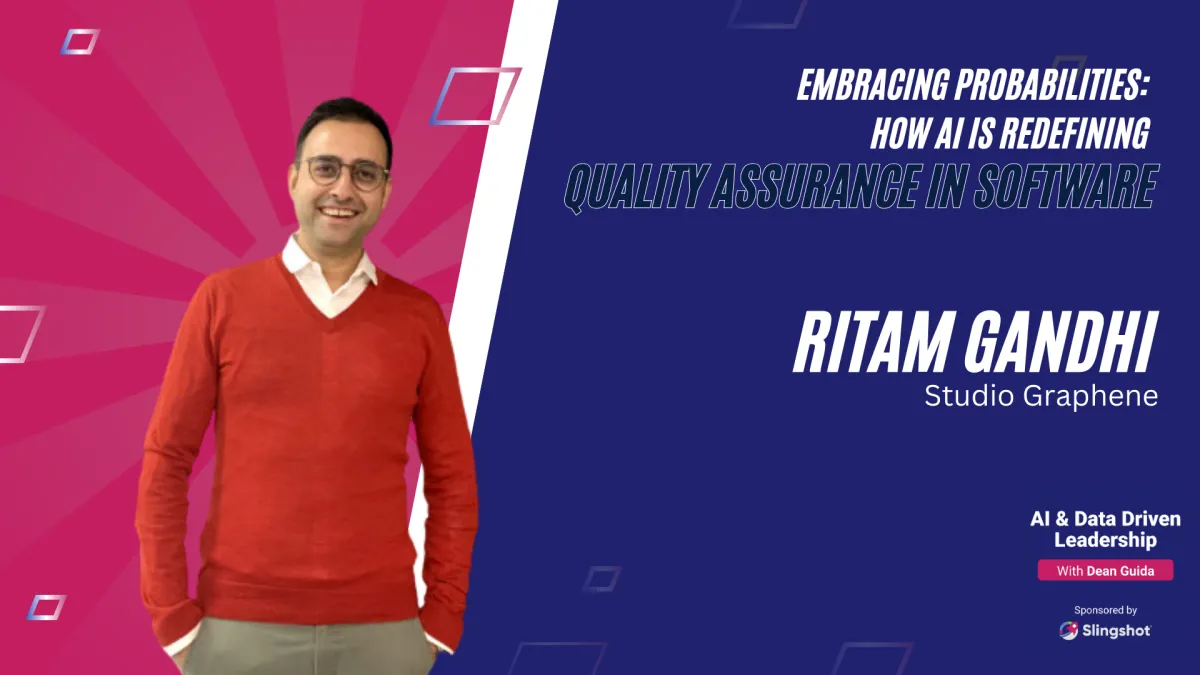
62 - Embracing Probabilities: How AI is Redefining Quality Assurance in Software
Embracing the AI-Native Future: Insights from Ritam Gandhi of Studio Graphene
In a recent episode of the AI & Data Driven Leadership Podcast, host Dean Guida sat down with Ritam Gandhi, the Founder of Studio Graphene, to explore the profound shift from traditional software development to an AI-native paradigm. As organizations grapple with the rapid evolution of generative technology, Ritam shares his seasoned perspective on why "bolting on" AI as a feature is a recipe for obsolescence. This conversation provides a strategic roadmap for leaders looking to reimagine their product architectures, balance deterministic reliability with probabilistic innovation, and foster a distributed culture of AI fluency that drives measurable business value in an increasingly automated world.
Navigating the Shift to AI-Native Product Development
The transition to becoming an AI-native organization requires a fundamental departure from traditional, rule-based software thinking toward a hybrid model that blends deterministic and probabilistic elements. Ritam Gandhi explains that while mission-critical systems—such as financial compliance or medical diagnostics—must remain deterministic to ensure predictable and testable outputs, the next generation of user experience thrives on the probabilistic nature of AI. By designing workflows that assume AI will handle core reasoning tasks from the start, companies can move beyond simple automation to create products that are inherently adaptive. This approach necessitates a "graceful failure" design philosophy, where systems are architected to handle the inherent unpredictability of AI models without compromising the overall integrity of the user journey.
Distributed leadership is the catalyst for scaling this AI-native mindset across a modern enterprise. Rather than siloing data science and AI expertise within a single, centralized department, Ritam advocates for empowering every functional unit—from marketing and finance to engineering—to pilot their own AI initiatives. This decentralization ensures that those with the most contextual domain expertise are the ones guiding the implementation of the technology, leading to faster adoption and more relevant innovation. When product managers use AI for rapid prototyping and finance teams leverage it for anomaly detection, the technology stops being a distant corporate mandate and becomes a core competency that enhances the specific value proposition of every team.
Measuring the true business impact of these initiatives requires moving past vanity metrics toward data-driven KPIs that reflect productivity, quality, and feature adoption. For an AI-native strategy to be sustainable, leaders must instrument their systems to correlate AI tool usage with tangible outcomes, such as reduced defect rates in code or faster pull-request cycles. This evidence-based approach allows organizations to iterate quickly, doubling down on the probabilistic features that drive user satisfaction while maintaining strict deterministic guardrails where they matter most. Ultimately, the success of an AI-driven SaaS product depends on this rigorous alignment between technical experimentation and a hyper-focus on the ideal customer profile’s real-world needs.
About Ritam Gandhi
Ritam Gandhi is the Founder of Studio Graphene, a digital agency that specializes in helping startups and established enterprises design and build innovative tech products. With a background in management consulting and a passion for early-stage ventures, he has led his team in delivering hundreds of digital solutions, ranging from complex IoT platforms to AI-native SaaS applications.
About Studio Graphene
Studio Graphene is a London-based digital product studio that partners with visionaries to turn bold ideas into impactful technology. The agency focuses on a collaborative, human-centric approach to design and development, helping organizations navigate digital transformation through rapid prototyping, scalable architecture, and the strategic integration of emerging technologies like AI.
Links Mentioned in This Episode
Key Episode Highlights
AI-Native vs. AI-Added: Why the most successful future products will be built with AI as the foundational starting point rather than a secondary feature.
The Hybrid Software Model: A framework for balancing deterministic (predictable) guardrails with probabilistic (AI-driven) innovation to minimize risk while maximizing value.
Distributed AI Culture: The importance of decentralizing AI responsibility to allow domain experts in every department to drive contextual experimentation.
QA for Probabilistic Systems: How quality assurance must evolve from fixed test cases to exploratory testing and user feedback loops to handle AI "hallucinations."
Scaling SaaS with AI: Lessons on why technical excellence must be paired with a narrow focus on the Ideal Customer Profile (ICP) to achieve market fit.
Conclusion
The conversation with Ritam Gandhi highlights that the true power of AI lies not in its ability to mimic human tasks, but in its potential to serve as the core engine for entirely new types of digital experiences. By embracing a distributed culture of experimentation and balancing technical agility with rigorous data-driven metrics, leaders can successfully navigate the complexities of the AI-native era and build resilient, future-ready organizations.
Explore Slingshotapp.io to learn more about AI-driven leadership solutions, and if you’re a qualified leader interested in sharing your insights, apply to be a guest on the AI & Data Driven Leadership Podcast here.


